

2026 marks the ten year anniversary of the first megagame I designed, Everybody Dies.
No, this is not when I announce a ten-year anniversary special game, although I do still get asked about when I’m planning to run it again!
Instead, I’d like to share some of the elements of the game design I’m proudest of… and which three things I’d want to change if I was designing it over again from scratch.
Did you know that the core game handbooks for Everybody Dies are available to download for an optional donation?
What is Everybody Dies?
Everybody Dies is a Game of Thrones megagame by BeckyBecky. It was first run in November 2016, and has had a series of reruns and rewrites in the years since: a larger rerun in April 2017 (Everybody Dies Harder), a time shift rewrite in September 2018 (Everybody Dies 3: Playing with Fire) and a more substantial rewrite of the original game in November 2022 (Everybody Dies Again).

The original game was set during Robert’s Rebellion / the War of the Usurper, seventeen years before the events of the Game of Thrones book series and TV show. This was when the Mad King Aerys was on the throne of the Seven Kingdoms, but war and intrigue was afoot and many in the kingdom wanted him deposed in favour of his son Rhaegar. In the canon, the tides ended up turning against Rhaegar and Robert Baratheon became king, but since the story began before Rhaegar ran off with Lyanna Stark, everything ended up pretty differently in each of the three OG-setting runs!
ED3 Playing with Fire was a rewrite set during the Dance of the Dragons, which has now of course been televised as House of the Dragon.
Players took the roles of Lords and Ladies Paramount, bannermen, Small Councillors, maesters, bards and religious representatives such as Septas or Red Priests. It was a roleplay-heavy game but, with an enormous map of Westeros dominating the middle of the room, there was a fair amount of military conflict as well.
Favourite design aspect #1: The Small Council Game
Part of the reason I chose to set Everybody Dies during the War of the Usurper was because I liked the idea of having a council game where players were trying to mitigate the whims of a chaotic King.
Nine players took part in the Small Council each turn, a council mechanic that combined in-character discussion with blind bidding mechanics and a penalisation system for voting against Aerys, who was represented by a Facilitator. The mechanic was originally based on the Hitler’s Henchmen mechanic from Jim Wallman’s The Last War megagame but underwent several design iterations to create something utterly unique.

Each turn, the councillors voted in favour of or against one of four Matters put forward by the King. These could be sensible, such as naming a new knight to the Kingsguard or raising taxes in a Region. They could be wildly impractical, such as legitimising all bastards in the Seven Kingdoms. Or they could be batshit insane, such as appointing a horse to the Small Council. The crucial part of the game was, chances are you could only dissuade the King from one idea each turn. And the person who voted most against a Matter that failed would see the King’s wrath come down upon them!
Many players within the council stated that this was one of their favourite parts of the day – the only downside being that when Aerys was inevitably killed, the game had to end!
A non-Game-of-Thrones version of the Small Council Game is available for purchase for just £10.
Favourite design aspect #2: Dragons
When I decided to redesign Everybody Dies for a different period in Westeros history, there was just one that jumped out at me – the Dance of the Dragons, a civil war between two sides of the Targaryen family that ended in the demise of nearly all their dragons.
The downside was that, with no Mad King, there would be no Small Council Game. So I needed a truly epic mechanic to replace it. Enter – DRAGONS.
There were multiple aspects to the dragons mechanic. Firstly, there were the dragons that players controlled. The smaller dragons were represented on the map by tiny figurines, but as dragons got larger, so did their markers – the monstrous Vhagar was an actual foot-high dragon statue! If he landed in your Region, you definitely knew about it.
Dragons also took part in combat, which was not the slam-dunk you might think it would be, since both sides were fielding them! This gave rise to some very fun Tactics cards, including “Get Over Here You Big Bastard”, which could force a dragon to target you in combat as opposed to a more vulnerable ally!
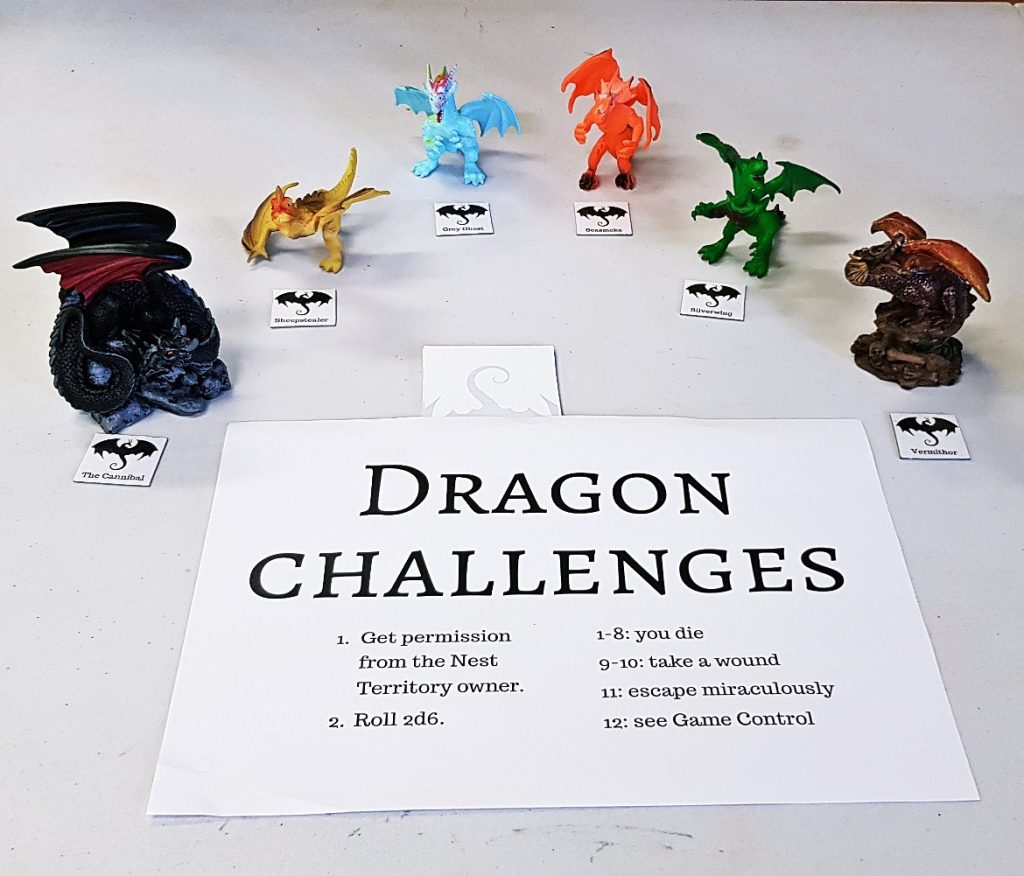
But perhaps the coolest part of the dragon mechanic was the Wild Dragons. There were several at the start of the game, and ANY player character could attempt to claim one. This was wildly dangerous and incredibly inadvisable… so naturally multiple players gave it a go. You had to travel to the Crownlands (already risky) and then roll two d6. You got a few buffs if you were Valyrian etc. On an 8 or less.. you DIE. On a 9-10, you are wounded. On an 11, you escape with your life. On a 12… see Game Control, because you’ve just won yourself a dragon.
Reader, no one won any dragons, but it sure was fun to watch.
Favourite design aspect #3: The briefings
The heart of the Everybody Dies game lay in the individual character briefings. For the original game, there were 79 starting characters, and for each one I wrote a 1-2 page briefing, including personal history, and relationships with other played characters. These were detailed prose!
And then because it’s Everybody Dies, some characters are going to die! So I wrote at least a dozen backup characters for anyone who died and didn’t take on the role of their heir.
And then for Everybody Dies Harder, I wanted to expand the game a little, so I added about 10 new characters to the game, each of which needed their own briefing.
And then of course for ED3, I completely changed the setting and had 71 completely new characters who… all needed new briefings.

Many of the briefings borrowed heavily from the books, but for a lot of them I needed to change details or invent connections with other characters. And for some I had to create entire plots, realistic backstories that fit within the world of Ice and Fire.
A special shoutout to Hottan Coldwater, a background character from the first game who became a player character in a later run. I think GRRM (who named three Tullys Grover, Elmo and Kermit) would have approved.
Favourite design aspect #4: The secret plots
Everybody Dies is a story-driven game across multiple layers. There’s the individual briefings, the region-wide concerns, the overarching political drama… but underneath it all, there were secret plots designed to bind the world closer together, sow discord and drive specific parts of the action forward.

I don’t want to give too much away in case it does get run again and I reuse any of the hidden plots, but I will share one that has entered my personal headcanon ever since I thought it up.
The Maesters have sworn to drive magic in all its forms from the world. They were behind the extinction of the dragons, they study magic only to understand how to counter it, and, most significantly for this game, they aim to eliminate House Targaryen from the world.
Each team had a maester, who were some of the only players allowed to move and communicate freely around the room. They were often sent to communicate important messages on behalf of their lords. But with this clear tension between their task and their calling, whether those messages always got there in one piece remains to be seen.
Of course, for each run I had to change up the plots, for the maesters and other factions. Which will be in play if I do run it again? Maybe I’ll have come up with something new by then.
There’s another secret plot that I absolutely love, but I don’t want to give away all my secrets…
Favourite design aspect #5: Opportunity Cards
The final design aspect I’m proudest of is Opportunity Cards. Each player started the day with at least two of these cards, personalised to their specific character.
Some cards were straightforward – your family owns a Valyrian steel sword. Some granted special abilities – Tywin Lannister could travel between Casterly Rock and King’s Landing in a single move. Some were quest-based, granting an in-game boon for gaining a seat on the Small Council or taking revenge on an enemy. Some were even anti-quests, granting an advantage in a battle, but you had to surrender the card if you got married.

It was how we managed special privileges for Small Council posts (the Master of Coin could steal a small amount from the Treasury each turn without getting caught). It ensured revered fighters won more duels than they lost, and the “Fierce Fighter” card also ignored the first wound you took in the game. It was how Maesters made use of their learning, religious representatives invoked their deities and bards got more gossip.
One card in particular “Protection of R’hllor”, made a huge impact in the first game. The Red Priest Jhalo had an Opportunity Card reading “If you would die, see Control.” Control then gave the player a second wound sticker (normally your second wound killed you) and sent him back to the game with the clear instruction that if he basically got a single scratch, he would fall over dead.
But legend started to spread of a Red Priest that couldn’t die, and he survived the entire game with everyone at least a little bit afraid of him.
Thing to change #1: Communication restrictions
Everybody Dies breaks with many megagame conventions by having strict communication restrictions. Rather than being able to speak to anyone in the room pretty much whenever you want, players could only speak to others within the same Region as them. There were set points in a turn when you could switch Region, but even that wasn’t free travel – you couldn’t go directly from the North to Dorne, for example!
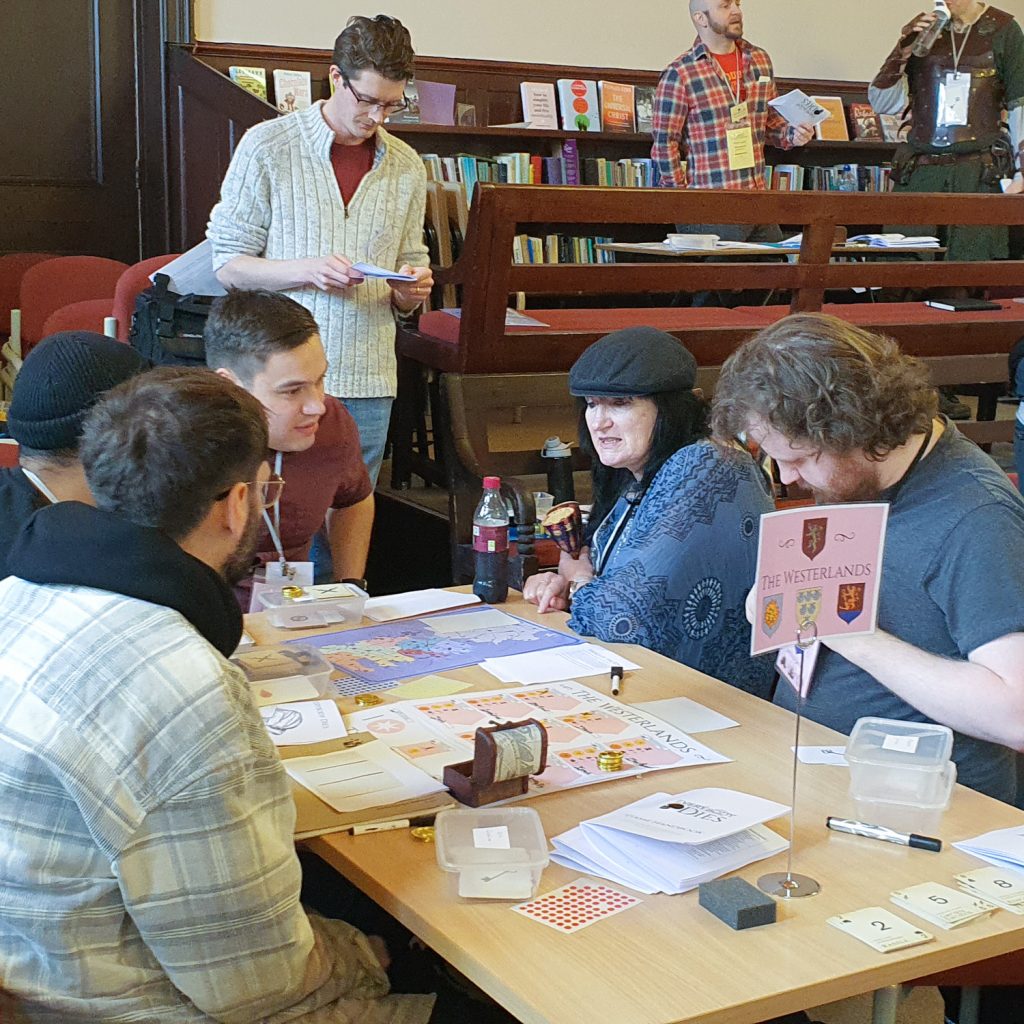
This was crucial to the design for two reasons. Firstly, the world of Westeros is big and there are no emails or phone calls! In the real setting, you can’t just chat to your bannerman on the march to update orders or have diplomatic talks with an enemy on the other end of the realm. You have to send envoys, travel, put yourself at risk. Of course, letters do exist, sent by ravens…
Ravens controlled by the maesters, bringing us to the second reason. The maesters could move freely, as if carrying the ravens’ messages themselves. However, they were not neutral actors, and part of the game relied on them not being 100% reliable!
However, it was a fairly unpopular mechanic, and very challenging to enforce. I’m not sure that this sort of communications restriction belongs in a megagame, but since it’s so integral to the design, it would be hard to remove it completely. I hadn’t found a compromise I was happy with by the latest run of the game – any ideas?
Combat system
I wanted combat within Everybody Dies to feel thematically linked with the setting, so went through a lot of design iterations to get it exactly how I wanted it. The trouble is, I never got there! I never tend to choose combat roles within megagames myself, so perhaps I was chasing after an idea that didn’t exist.

Combat was card based, and you got combat cards from the territories under your control. It was also group-based, with you and your allies lining up against your opponents. Each combat card had an attack value and you could play tactics cards to modify combat numbers. It was complicated and took a little while to resolve, but I tried to balance that against the capacity for player choice.
I redesigned the combat system for Everybody Dies 4 to simplify it further without removing the theming and player choice, but honestly I still wasn’t 100% happy with it.
Facilitator numbers
Some megagames manage to run with a very small Facilitator team. I think Den of Wolves can go up to about 40 players with just one or two Control!
Everybody Dies is at the other end of the spectrum. Each run has had around 18-20 facilitators for 70-90 players, so that’s a Control-to-player ratio of around 4-4.5 players per Control.
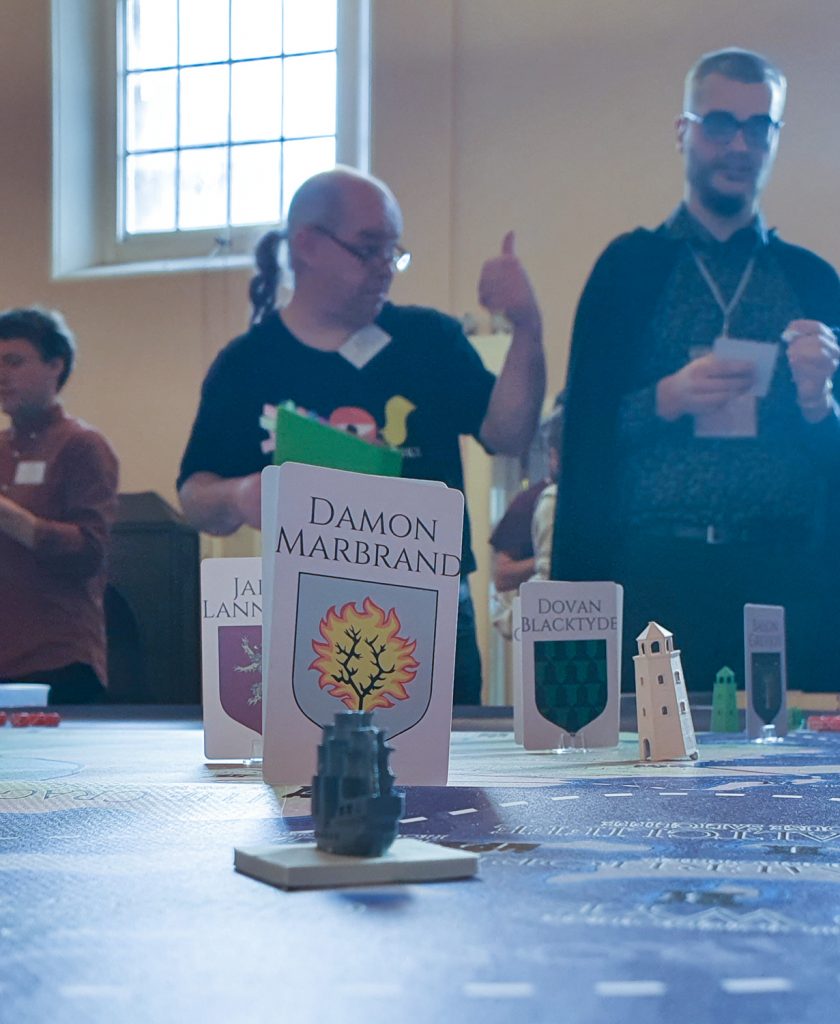
The reason for this was that I wanted each Region of 5-8 players to have their own Facilitator to manage region specific conflicts. And then there’s the other Control that make sense for the game – a few Map Control to handle map movement and combat, a Small Council / Aerys Control, New Player Liaison, a couple of Bard Maester Religion Control, and me as Game Control. It adds up and means you have a LOT of Facilitators on hand.
I honestly credit part of the success of this game to ensuring that there is heavy Facilitator support for all the players.
However, it means that deciding to run a game means asking 20 of the keenest bods to help you run it rather than play. It makes the game very challenging for other groups to put on. And it’s honestly out-of-step with most other megagame designs.
Summary
Everybody Dies will likely remain my magnum opus for a long time. I probably sunk the equivalent of full months of hours into the game. I developed it for longer than I was pregnant with my daughter or studied towards my degree. Seeing people enjoy it at every single run of the game brought me unimaginable joy.
But it’s definitely been put back on the shelf indefinitely. I doubt I will ever run it again.
Purchasing Everybody Dies
However, it may come back out of retirement in another way.
Firstly, you can currently download the core game handbooks for an optional donation. You can also buy a non-Westeros version of the Small Council Game for just £10.
Finally, if you are interested in running Everybody Dies, I am open to discussions about licensing the game – though of course, please read the caveats above, as this game isn’t for every megagame group!
Have you played in Everybody Dies? What was your favourite part of the game? What would you have changed?